Here Are Some Reasons Why--

Here to amuse, never abuse. It's a blog-o-entertainment.
Saturday, August 4, 2007


Jordin Sparks Shows Why She Is Special.
I found this video on YouTube, and thought, how nice that Jordin Sparks, who must obviously be a very busy gal these days, would do this after a concert for a fan of hers. This video was taken by YouTube member LaUrAxBeThx at an American Idol Concert in Houston on July 15, 2007. She did this for LaUrAxBeThx and her twin sister. Love her or hate her, this off the cuff performance of Amazing Grace is a wonderful, spur of the moment, acapella performance.
Friday, August 3, 2007
Remember American Idol's Sabrina Sloan? No? She's Gonna' Help You Remember!

Sabrina Sloan was a Season Six AI Contestant that didn't quite make it to the finals. And now she has joined William Hung as one of only two non-finalists to get a recording contract. With her background in music in college and having performed in the musical Hairspray, it shouldn't be a surprise. Now keep reading to see who she will be teeming up with.
American Idol's Sabrina Sloan has signed a recording contract with Universal Motown, and her first project will be a CD of duets with fellow season 6 semifinalist Sundance Head. ''The feel will be soulful songs with a contemporary twist — kind of Al Green meets OutKast,'' said Sloan, noting that she and Head will hit the studio in August, with the hopes of making a late November release date.
Jolene Cherry, senior VP of A&R at Universal Motown, said the album will be produced by Peter Collins (Bon Jovi, Rush) and include a mix of new and classic material. ''I usually am not so much in sync with things that are on American Idol,'' Cherry noted, ''but both [Sloan and Head] really caught my attention. I was really impressed by the quality of their vocals.''
An AI Performance By Sabrina Sloan
Sloan, the last female semifinalist voted off Idol before the season 6 finals began, said that an executive from Universal Motown tracked her down via a member of her mother's Arizona church congregation in the days after her ouster.
And despite some initial reservations about the duets concept, Sloan said she hopes the combined power of hers and Head's fan bases will help them get noticed in a music scene increasingly crowded with Idol alumni. ''We had a fear of having a whole From Justin to Kelly thing. We didn't want to make anything cheeseball,'' Sloan explained. ''But Jolene and the [people at the] label said, 'It cannot be that.' We're putting it out at the same time as [season 6 winner and runner-up] Jordin [Sparks] and Blake [Lewis]. It's got to be killer.''
And Here's Sundance
Still, Sloan added, in the long-term, both she and Head consider themselves solo artists. ''It's not going to be a long-term [partnership], like Peaches & Herb,'' she said with a laugh.
Aside from Mario Vazquez, who chose to drop out of Idol just prior to the season 4 finals, and novelty act William Hung, Sloan and Head appear to be the first Idol contestants to score major label deals without reaching the top 12.
Thursday, August 2, 2007
A Look Back At Another Bridge Disaster And Lessons Unlearned
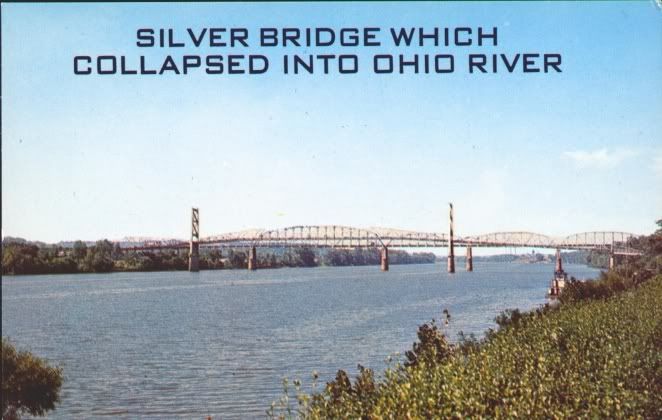
On December 15,1967 at approximately 5 p.m., the U.S. Highway 35 bridge connecting Point Pleasant, West Virginia and Kanauga, Ohio suddenly collapsed into the Ohio River. At the time of failure, thirty- seven vehicles were crossing the bridge span, and thirty-one of those automobiles fell with the bridge. Forty- six individuals perished with the buckling of the bridge and nine were seriously injured. Along with the numerous fatalities and injuries, a major transportation route connecting West Virginia and Ohio was destroyed, disrupting the lives of many and striking fear across the nation.
This is the collapse of the bridge as depicted in The Mothman Prophecies with Richard Gere.
The General Corporation and the American Bridge Company constructed the Highway Bridge in 1928. It was designed as a two-lane eye-bar suspension type bridge, measuring 2,235 feet in total length, including the approaches. The bridge was designed under the specifications set forth by the American Society of Civil Engineers.
The bridge was dubbed the 'Silver Bridge' because it was the country's first aluminum painted bridge. It was designed with a twenty-two foot roadway and one five-foot sidewalk. Some unique engineering techniques were featured on the Silver Bridge such as 'High Tension' eye-bar chains, a unique anchorage system, and 'Rocker" towers. The Silver Bridge was the first eye-bar suspension bridge of its type to be constructed in the United States. The bridge's eye-bars were linked together in pairs like a chain.
A huge pin passed through the eye and linked each piece to the next. Each chain link consisted of a pair of 2" x 12" bars and was connected by an 11" pin. The length of each chain varied depending upon its location on the bridge.
Some questions were raised when this design idea was brought forward. What if the two eye-bars did not share the 4 « million pound load of the bridge equally? Would the eye- bars fail under the overloaded stress? The designers thought they had an answer. The answer come in the type of material used for the eye-bars. The American Bridge Company developed a new heat-treated carbon steel to use on the construction of the Silver Bridge. This new steel would allow the individual members of the bridge to handle more stress. Along with the two eye-bars sharing the load, the steel could easily handle the 4 « million pound load. The newly treated chain steel eye-bars had an ultimate strength of 105,000 pounds per square inch (psi) with an elastic limit of 75,000 psi along with a maximum working stress of 50,000 psi. The eye-bars embedded into the unique anchorage were also heat treated for an ultimate strength of 75,000 psi, an elastic limit of 50,000 psi and a maximum unit stress of 30 psi.
Because of the unique design of the structure, the anchorage design needed to be innovative. Bedrock was only found at a considerable depth, making the ordinary gravity type anchorage impractical. An unusual anchorage was designed consisting of a reinforced concrete trough 200 feet long and 34 feet wide filled with soil and reinforced concrete. The huge trough was supported on 405 sixteen inch octagonal reinforced concrete piles in which the cable pull is resisted by the weight of the anchorage and by sharing the halves of the piles.
Another unique design technique used on the Silver Bridge was the 'Rocker' towers. The innovative towers, which had a height of 130 feet, 10 1/4 inches, allowed the bridge to move due to shifting loads and changes in the chain lengths due to temperature variations. This was done by placing a curved fitting next to a flat one at the bottom of the piers. The rocker was then fitted with dowel rods to keep the structure from shifting horizontally. With this type of connection, the piers were not fixed to the bases.
For thirty-nine years the Silver Bridge stood, allowing passage across the Ohio River. With the previous inspections, no one conceived that the structure might fall and collapse into the riverbed. On that fateful December 15, 1967 evening, tragedy struck. Within seconds, the Silver Bridge had collapsed killing and injuring many individuals.
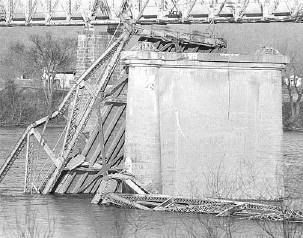
Many people were out buying Christmas trees, enjoying the holiday season, unaware of the disaster, until they heard the sound. Some individuals said, 'the sound of the collapse was like that of a shotgun." For those who saw the bridge collapse, they said, "it looked like the bridge fell like a card deck." Whatever the case, when the structure fell, horror captivated the area and lives were changed forever.
Many heroic eyewitnesses tried to help the victims who fell in the water. Rescue crews were on the disaster scene within minutes and were able to save some of the people from drowning in the Ohio River. Witnesses indicated that many of the vehicles were floating downstream while passengers would beat on their windows trying to escape. One eyewitness described seeing a truck driver standing on the top of his truck cob yelling for help as his vehicle slowly floated downstream in the cold water. William Needham, a truck driver from Kernersville, North Carolina, barely escaped death. He was in the cab of his truck driving across the bridge, when the collapse occurred. He managed to survive, but his partner in the truck cab never escaped the water of the Ohio River. His partner was asleep in the rear cab and had strapped himself in for safety. When the bridge collapsed, he had no chance of escaping. Needham claims that the truck sank to the bottom and that he narrowly escaped. He broke the window to the cab, grabbed a box to help himself surface, and barely made it to the top of the water before he ran out of breath.
Another survivor, Howard Boggs, of Gailipolis, Ohio, lost his small family in the fall. His wife, Marjorie, and seventeen-month-old daughter were in their vehicle when the bridge collapsed. He claims that Marjorie noticed that the bridge was 'quivering' as they became stalled on the bridge in the heavy rush hour traffic. She then asked, "What will we do if this thing breaks?" The next thing Boggs remembers was scrambling for his life by breaking out his car window. Sadly, his wife and child perished in the accident. He could not aid them in their attempt to be freed from the sinking car.
After the collapse, many residents questioned why the bridge would suddenly fall into the river below. Three of the reasons that were commonly heard were:
A supposed 'Sonic Boom' prior to the collapse.
The 'Curse' of Chief Cornstalk.
Structural failure of a bridge member.
The collapsed bridge needed to be thoroughly inspected before the cause could be determined. Without concrete reason for the bridge's failure, every suggested reason was researched until proven incorrect.
Many people in the West Virginia and Ohio area claim to have heard a 'Sonic Boom' around the same time, or just moments before the bridge fell. Investigators checked with the nearby military installations, and there were no aircraft capable of producing a Sonic boom in the area at the time the bridge dismembered. The theory was proven false after the researcher's investigation showed that surrounding buildings were not damaged. If a sonic boom had occurred in a residential community, the overpressure would have caused extensive damage to homes and other structures in the Point Pleasant area.
Older residents claimed that the cause of the bridge collapse was "The Curse of Cornstalk." In 1774, the Battle of Point Pleasant took place between approximately 1,000 white men and 1,000 Indians. The commander of the Indian war party was Chief Cornstalk, a well-respected and intelligent Indian leader. During the battle, Cornstalk could see that defeat was imminent for his forces. He therefore let his troops make a crucial decision, either to fight to the death or surrender. The Indian warriors chose to surrender. With the surrender, Chief Cornstalk signed the Treaty of Camp Charlotte.(16) Chief Cornstalk and his son were later captured and murdered along with his son at Fort Randolph. Legend states that in his dying words Chief Cornstalk, still upset over his troops defeat, placed a curse of death and destruction upon the entire Point Pleasant area.(17) Could this be the reason for the collapse of the Silver Bridge? After thorough investigations of the bridges' collapsed structure, 'The Curse of Cornstalk' was ruled out as a contributing factor to the collapse of the Silver Bridge.
After extensive studies of the broken structure members, the cause of failure was determined. The answer was the unique eye-bar design made from the newly innovated heat treated-carbon steel. The old saying, "A chain is only as strong as its weakest link," turned out to be a fact in the failure of the Silver Bridge.(18) The heat-treated carbon steel eye-bar broke, placing undue stress on the other members of the bridge. The remaining steel frame buckled and fell due to the newly concentrated stresses.
The cause of failure was attributed to a cleavage fracture in the lower limb of eye-bar 330 at joint C13N of the north eye-bar suspension chain in the Ohio side span." The fracture was caused from a minute crack formed during the casting of the steel eye-bar. Over the years, stress corrosion and corrosion fatigue allowed the crack to grow, causing the failure of the entire structure. At the time of construction, the steel used was not known for subduing to corrosion fatigue and stress corrosion. Inspection prior to construction would not have been able to notice the miniature crack. Over the life span of the bridge, the only way to detect the fracture would have been to disassemble the eye-bar. The technology used for inspection at the time was not capable of detecting such cracks.
Stress corrosion cracking is the formation of brittle cracks in a normally sound material through the simultaneous action of a tensile stress and a corrosive environment. Combined with corrosion fatigue, which occurs as a result of the combined action of a cyclic stress and a corrosive environment, disaster was inevitable for the Silver Bridge. The two contributing factors, over the years continued to weaken the eye-bar and unfortunately the entire structure.
Another major factor that helped corrosion fatigue and stress corrosion in bringing down the bridge was the weight of new cars and trucks. When the bridge was designed, the design vehicle used was the model-T Ford, which had an approximate weight of less than 1,500 pounds. In 1967, the average family car weighed 4,000 pounds or more. In 1928, West Virginia law prohibited the operation of any vehicle whose gross weight, including its load, was more than 20,000 pounds. In 1967, the weight limit almost tripled to 60,800 pounds gross, and up to 70,000 with special permits. Civil engineers must use a projected life span for nearly all projects, but no one could see that 40 years after the construction of the Silver Bridge that traffic loads would more than triple.
Although the collapse of the Silver Bridge was a major disaster in the West Virginia and Ohio areas, it also frightened the entire nation. The St. Mary's bridge, located upstream and similar in design to the Silver Bridge, was shut down for inspection after the collapse.(23) President Lyndon B. Johnson ordered a nation-wide probe to determine the safety of the nation's bridges. In 1967 there were 1,800 bridges in the United States which were 40 years old including 1,100 highway bridges designed for Model-T traffic. Many federal officials feared that other structures, built around the some time to handle Model-T traffic, could face the same fate as the Silver Bridge.
Even though the collapse of the Silver Bridge was a disaster, there were positive aspects to the failure. Bridge inspections are now more routine and in-depth because of the Silver Bridge. Engineers are now more knowledgeable about corrosion fatigue and stress corrosion, which allows better quality structures to be designed and built. With today's technology, as well as better design techniques and materials, there is hope that a Silver Bridge disaster will never again take place.
It looks like the last sentence in this article proved to be untrue.
Source: Corrosion-Doctors.Org
Collapse Of Minnesota Bridge Caught On Video

Shown exclusively on CNN before it was released to the rest of the media, this video is from a security camera that was pointed at the bridge.
Divers found more bodies in cars submerged in the Mississippi river yesterday as commuters told dramatic stories of the rush-hour collapse of an eight-lane motorway bridge in Minneapolis.
Dazed drivers described how their vehicles suddenly went into free fall as the 1,907ft (581m) bridge on Interstate 35 West plunged into the river 60ft below the bumper-to-bumper traffic shortly after 6pm on Wednesday.
“I slammed on my brakes and saw something in front of me disappear and then my car pointed straight down and we fell,” said Dennis Winegar, whose car fell 50ft and landed on another vehicle.
“Boom! Boom! Boom! And we were just dropping, dropping, dropping, dropping,” his wife Jamie said.
The official death toll of four was rising yesterday as more bodies were found. But dozens of people – including 60 children on a school bus that had just crossed the river on the way back from a swimming day trip – had lucky escapes.
Nina Jenkins, one of the children on the bus, said that the bus “kind of went up and then it just dropped. The driver went fast so she could get over the bridge.”
Officials said the fact that some lanes were closed for resurfacing work probably saved lives by restricting the number of vehicles on the bridge. But as many as 50 vehicles were still in the 7ft-deep water and police said that up to 30 people were still missing. Six of the 79 admitted to hospital were suffering from life-threatening injuries.
“There’s no question that the fatality number will go up,” said Tim Pawlenty, the Governor of Minnesota. “We know there are a number of cars in the water that we haven’t been able to get to and they’ve been there submerged since [Wednesday] evening.”
Rescuers were checking number plates on submerged cars yesterday to try to identify potential victims.
“The recovery involving those vehicles and the people who may be in those vehicles is going to take a long time,” Police Chief Tim Dolan said. “We’re dealing with the Mississippi river. We’re dealing with currents, and we’re going to have to do it slowly and safely.”
The bridge lies just a few streets away from the heart of Minneapolis, near tourist attractions such as the Guthrie Theatre and the Stone Arch Bridge, and links the two sides of the University of Minnesota campus. A baseball game between the Minneapolis Twins and the Kansas City Royals went ahead at the nearby Metrodome about an hour after the bridge collapsed because the organisers did not want to crowd the area with onlookers by sending fans home early.
Drivers said that traffic was crawling across the bridge at 10mph because of the lane closures when the main 500ft span collapsed. The disaster was captured by a security camera, which recorded the roadway buckling and then crashing into the river in a cloud of dust. Mr Pawlenty called it a “catastrophe of historic proportions”.
“The bridge started falling, cars were flying everywhere, and I saw the water coming up,” said Catherine Yankelevich, who climbed out of the driver’s side window and swam ashore after her car was thrown into the river. “It seemed like a movie; it was pretty scary.”
Janet Stately, who was driving home with her daughter, told CNN: “I heard a horrible noise and then I looked and it seemed like a piece of the bridge was pancaking and going down. Then there was another section that went down in a V, and all the cars were going down into the water like they were tiny toy cars.”
— A look at recent fatal bridge disasters in U.S. history:
• Bridge/location: Silver Bridge, Ohio River
Date: Dec. 1967
Deaths: 46
(This was not too far from my hometown and in fact the film The Mothman Prophesies was based on this incident.)
• Bridge/location: Sunshine Skyway Bridge, Point Pleasant, W.Va.
Date: May 1980
Deaths: 35
• Bridge/location: Schoharie Creek Bridge, Amsterdam, NY
Date: April 1987
Deaths: 10
• Bridge/location: Hatchie River Bridge, Covington, Tenn.
Date: April 1989
Deaths: 8
• Bridge/location: Zuber Creek Culvert
Date: Jan. 1983
Deaths: 5
• Bridge/location: Bridge over I-40 in eastern Oklahoma
Date: May 26, 2002
Deaths: 14
Wednesday, August 1, 2007
Clay Aiken: The JERICHO Connection

Clay Aiken is taking credit for keeping the CBS series "Jericho" on the air. A report from "In Touch Weekly" claims that after blogging about how upset he was when CBS cancelled the apocalyptic drama the American Idol star claims he encouraged his fans to take action. "Within a week, the Claymates had organized a campaign among Jericho fans to send nuts to CBS," says Clay. "And it's back on the air. It just blows my mind."
But Jeff Braverman, the CEO of nutsonline.com – the web site that helped angry Jericho fans send 20 tons of peanuts to CBS in protest – got a bit salty when he heard Clay's claims. "We never heard from him!" He says. "[Radio personality] Shaun 'Omac' Daily in Las Vegas came up with the nuts idea.
AIKEN'S EXCELLENT RENDITION OF THE STAR SPANGLED BANNER
Meanwhile, Jericho stars are happy the show is back. "I heard that Clay was a fan, but I never thought he'd rally his fan base," Skeet Ulrich tells In Touch. "I appreciate it!" Ashley Scott adds she's just glad Clay didn't watch the show that was competing against Jericho in the same time slot. "It's funny that Clay wasn't watching American Idol!" she says.
Skeet Ulrich says his mother sent him the Houston Chronicle article in which Clay boasted about saving Jericho. "If Clay wants to take credit, so be it. "Jericho is back," says Braverman, who helped organize the nuts campaign.
I guess he had to come up with something to get his name in the news since his career is stuck in neutral.
Tuesday, July 31, 2007
Diff'rent Strokes Star Gary Coleman In Trouble Again.

UPDATE: January 25, 2010
Looks like Gary Coleman is in trouble with the law once again. This time the news comes from Santaquin, Utah. The 41 year old Coleman was arrested in Utah on a warrant for failing to appear in court according to police. The "Diff'rent Strokes" actor was booked into the Utah County Jail on Sunday.
The Salt Lake Tribune reported that jail records show he was arrested after police received reports of a disturbance at his home.
* * * * * * * * * * * * * * * *ORIGINAL POST BELOW* * * * * * * * * * * * * * * * * *
PROVO - One of Utah County's more famous transplants has run afoul of the law.
Provo police cited actor Gary Coleman for disorderly conduct after witnesses said they saw him having a heated discussion with a woman last Friday evening.
Passers-by told police Coleman's temper was rising and he was hitting the steering wheel of his vehicle. The witnesses were concerned and called police.
When officers arrived, Coleman, known for his role in the TV series "Diff'rent Strokes," calmed down. He was issued a misdemeanor citation for disorderly conduct.
Coleman moved to Santaquin in 2005, around the time he starred in "Church Ball" an LDS-genre movie filmed in Utah County.
Below is a small video clip from when Gary was previously on trial for an assault charge.
Okay, I don't know about you folks, but doesn't this seem a little lame. If I was cited for all the times I've hit my steering wheel, I would be looking at a life sentence for repeated offenses.
Pirate Master Contestant Calls It Quits To Life

Mark Burnett's disappointing reality show "Pirate Master" has suffered another blow.
On the heels of the news of having its remaining five episodes yanked from CBS to go to streaming purgatory, it appears that one of its former contestants, Cheryl Kosewicz, was found dead in her home from an apparent suicide on Friday, July 27, reports Reno's KOLO-TV.
Kosewicz, a 35-year-old deputy district attorney, had spent more than six years prosecuting sexual abuse cases in Las Vegas.
Her death is still under investigation, but follows less than two months after the suicide of her boyfriend, Ryan O'Neil, who died on June 12. His death had hit the reality show contestant hard.
"Truthfully, I've lost the strong Cheryl and I'm just floating around lost," Kosewicz wrote in a June 28 comment posted on the MySpace webpage of fellow 'Pirate Master' contestant Nessa Nemir. "And this frik'n show doesn't help because it was such a contention between Ryan and I and plus its [sic] not getting good reviews."
Kosewicz was actually able to use her attorney skills to advantage the first time she was up for elimination on the show. Unfortunately, this didn't work the second time, and she became the fourth person to walk the plank.
Kosewicz is survived by her parents, brother, grandmother and additional extended family.
Kid Nation Controversy
Kid Nation Executive Producer Tom Forman is firing back at critics of his upcoming CBS reality series, calling the criticism “inaccurate and wildly premature.”
“None of these people have even seen the show yet,” Forman says. “But I lived it for 40 days.”
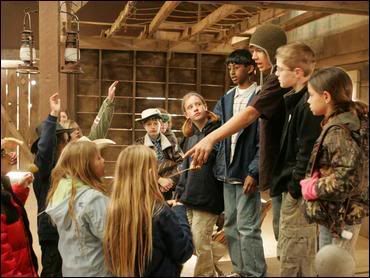
Forman’s remarks to B&C come in response to statements from children’s-rights activist Paul Petersen, who played Jeff Stone on The Donna Reed Show, in which he labels the new fall series a “travesty.” Forman was also hammered a few weeks back at the Television Critics Association press tour, and has faced repeated criticism on TV news programs.
Outrage over the series, in which 40 kids ages 8 to 15 are left alone for 40 days in New Mexico to self-govern a deserted ghost town, is off base, Forman argues.
“Over 40 days, I saw the kids rise to the challenge and run a world that is arguably better than the world in which they live,” he says. “It was an amazing, life-changing experience for everyone. The kids did remarkable things that will blow adults away.”
Critics have accused CBS of taking advantage of the children, forcing them to work 17-hour long days and duping the parents. But Forman says he initially flew all of the parents to California, where they “spent days talking this through. We continued to talk it through for the next month. They totally understood what they were getting into.”
And not only parents, according to Forman: “I spent hours upon hours upon hours with the children, their parents, their teachers and their superintendents to make sure that everybody knew exactly what we were going to do.”
Addressing accusations that the kids were neglected, Forman adds, “There were doctors, EMTs, child psychologists, wilderness experts, counselors and hundreds of other adults there to make sure that they were not just doing OK, but great. They never had to step in because these kids are much smarter, much more capable and, frankly, more excited to prove a point to America than these outside critics and self-appointed protectors give them credit for.”
Moreover, he says, “I am frustrated by the people who would deny them that opportunity, because they deny what I saw them do.”
Forman also denies that he had singled out New Mexico because of the lenient child labor laws there, insisting that he chose the location only after traveling to four different states and looking for “a terrific place to make a TV show.” Shortly after production had ended, the state closed a federal loophole exempting TV and film productions from those laws.
The executive producer also tried to clarify a remark he made at TCA, in which he likened the show to a summer camp. It was in reference to the harsh conditions of his own experience at camp, he says—not a legal designation the production used in order to skirt labor laws, as was widely reported.
“They took part in an experience,” Forman says of the kids. “We followed them some of the time with cameras.”
While efforts are underway to start the casting process for a second season, Forman says he is waiting to see if the show performs well enough to even get a pickup for another installment.
But after all the criticism, and with most states having tough child labor laws in place, Forman could have a tough time with the logistics of another shoot.
While he is confident a location can be found that is “safe, ethical and within the bounds of the law,” Forman acknowledges, “we have a lot to figure out.”
Can you imagine? People criticizing the "abuse" of children so that the American public can be entertained?
Kellie Pickler's Mom: Shame And Regret

Photo originally posted at: Clyde's All Purpose Corner
Choking back tears on the stage at Raleigh’s Walnut Creek Amphitheatre earlier this month, former “American Idol” sweetheart Kellie Pickler sang a song of questions to the mother who abandoned her.
In a church sanctuary not five miles away, Pickler’s mother, Cynthia Malone, prayed once more for the strength to fully forgive herself for deserting Pickler as a toddler.
What was once a mother’s private shame has become national intrigue as Pickler, 21, a budding country music vocalist, penned a song about a little girl’s longing for a vanished mother. “I Wonder” is climbing the Billboard Hot Country Songs list, hitting No. 15 this month.
Malone said it was hard to hear the first words her daughter had spoken to her in a decade uttered in a song on the radio. The lyrics are more mournful than angry, more pitiful than judging, but Pickler poses painful questions:
“Did you think I didn’t need you here/To hold my hand/To dry my tears/Did you even miss me through the years at all?”
The song – and Pickler’s discussions about her tough childhood – unleashed a range of emotions for Malone. Embarrassment faded to anger, which turned to hurt. Now, Malone is using the conversation that Pickler started in a song to speak to strangers about her struggles.
Malone, 38, spoke earlier this month about leaving her daughter and her efforts to escape abusive relationships. She said she is finally free and healthy and wants to help other victims of domestic violence. She has joined with Interact, the domestic violence support center in Wake County, N.C., to assist victims and hopes her unwelcome fame as Pickler’s estranged mom will make them listen.
“I can’t change anybody’s mind or their perception of me,” said Malone, widening dark eyes that match her daughter’s. “But, if I had a dream, it would be to help one girl. To let her know that you don’t have to do it by yourself.” Pickler declined through her publicist, Wes
Vause, to comment for this story. Vause said Pickler’s song captures her thoughts best.
Pickler sings in part: “Forgiveness is such a simple word/But it’s so hard to do when you’ve been hurt.”
Pickler’s father, Clyde “Bo” Pickler Jr., 42, whom Kellie has described as an alcoholic often jailed during her childhood, is behind bars again. He was convicted last week of stealing cars and pawning them for scrap metal, a Stanly County, N.C., Sheriff’s Office official said. Clyde Pickler is also on probation for assaulting his current wife with a steak knife. His attorney did not return calls.
Malone was 16 and a country girl living in Stanly County when she fell for Clyde Pickler. He pulled up to her window at a local McDonald’s drive-thru. She was smitten, and quickly they became a pair.
“He told me everything I wanted to hear,” Malone said. “He told me he loved me, that I was pretty, that he wanted to be there and protect me from my dad. I wholeheartedly believed him.”
Soon, Malone got pregnant with Kellie. She said she resisted family pressure to have an abortion and married Clyde Pickler instead. That was when the trouble started.
The beatings came fast and furious, Malone said. She tried to shield her bulging belly and had to take medicine to temper premature contractions.
Kellie’s birth in 1986 seemed to unleash even more violence in their home. Malone said she called police so many times that officers knew her by name. Once, she said, her husband threw her through a glass shower door and choked her before vanishing. For three days, Malone said, she wrapped Kellie in blankets and hid her behind their bed, in case her husband returned in a rage.
Court and police records from these years are scattered and incomplete. Clyde Pickler was convicted of assault by pointing a gun in 1986; the victim was a family member of Malone’s. Malone described the abuse as far back as 1988 in custody and divorce records.
Malone said she has never known her former husband to harm Kellie.
“He wouldn’t,” she said. “She’s blood. His princess.”
By the summer of 1988, Malone had had enough. She had shut down and could think of little more than survival.
“When you’re in that place, you have to make a decision: her life or yours,” Malone said during an emotional five-hour interview. “I’d given her life, but I didn’t want to lose mine.”
The morning after an immobilizing beating, Malone said, she dropped 2-year-old Kellie off at her in-laws’, stuffed a few items in her car and headed off to hide with family. She grabbed a few baby pictures, Kellie’s baby blanket and the outfit she brought her home from the hospital in.
Malone told no one she was leaving.
A year later, Malone showed up at a custody hearing to try to preserve some custody rights to Kellie. Clyde Pickler’s parents, Clyde Sr. and the late Faye Pickler, asked a judge for full guardianship. Malone said she disappeared again after her husband threatened her life if she reappeared.
Malone stayed gone for many years. She would drive by her former in-laws’, though, and park near the road to catch a glimpse of Kellie playing in the yard. She looked happy, Malone recalled.
In 1995, Malone got herself together enough to reunite with her daughter. A judge granted her custody. Kellie was in the fourth grade.
Malone said it was good for about a day; the two baked cookies and played checkers.
Soon, their relationship unraveled. Malone said Kellie desperately longed for her grandparents. She threw fits and threatened to kill herself, Malone said. Kellie’s grandparents alleged in court records that Malone abused Kellie; a judge found her not guilty of child abuse.
Eventually Malone surrendered, heartbroken. She turned Kellie back over to the Picklers and took off again.
“I don’t know what was hardest,” Malone said — “watching her from afar or having her wrapped up beside me.”
It has been 10 years since the two have met. Malone said she lived for the glimpses of her daughter on “American Idol” in 2006. She recorded each episode and watched it again and again. She raves about Kellie’s voice.
In the years since they have parted, Malone has struggled. She said she survived a series of violent relationships and barely escaped with her life in 2002. An estranged husband lay in wait for her, Malone said, and attacked her. She suffered major brain damage and had to learn to walk and talk again. She has had eight surgeries to rebuild a shattered face and replace her teeth.
Pickler landed a recording deal with BNA Records and 19 Recordings and left to launch her career. She fills her mom in on her adventure in the last verse of “I Wonder.”
“And just in case you’re wondering about me/From now on I won’t be in Carolina/Your little girl is off/Your little girl is off/Your little girl is off to Tennessee.”
Source: The Buffalo News as reported by Mandy Locke.
I wonder why it is all of the female idol contestants feel compelled to train wreck the national anthem.
When I found this video on YouTube, I found the following comments on Kellie kind of interesting.
dipatti (9 hours ago)
Kellie, who is "THEY" that "kicked you off" and might get "you in trouble"? I thought so HIGHLY of you until hearing this junk! It was your fellow citizens who voted other contestants on ahead of you--not the Idol staff "kicking you off." And IF you are "in trouble" then it's because YOU violated the terms of your contract with them. IF you badmouthed them, you were revealing your own negativity. For the sake of the Kellie Pickler that we love, please be more reasonable!
aimeechrister (5 days ago)
Of course Kellie Pickler is better than Kelly Clarkson, and quite a lot more famous than Kelly is as well, that's why Kellie has been the most searched person on the web so many times while Kelly "whats her face" never is. But it's not fair to compare Kelly "whats for face" to Pickler because when it comes to personality Kellie outshines most in the entertainment business. That's why she is the most searched while the others "aren't".
aimeechrister (6 days ago)
Where is Kellie now, right now she is singing on the hottest tour in country music today, not that I'm surprised that it became the hottest tour since Kellie is performing on it. And where is Kelly Clarkson? The last I heard she cancelled her tour this summer because she couldn't get anyone to buy her tickets. Doesn't sound too promising, but hey, if things don't work out for Clarkson maybe Sanjaya will be nice enough to hire her as a backup singer or something.
I didn't realize that Pickler fans are so jealous of Kelly Clarkson's career that they would make such ridiculous comments as the last two. It seems that their attitudes are as nasty as Pickler's singing. The first comment, well, I just found it funny.
Subscribe to:
Posts (Atom)
LinkWithin

Get The Official Blog-o-Rama Widget!
Keep up with all the latest info on the blog-o-rama by posting this to your blog or my space page. You can also scroll this widget to go directly to the latest article that you are interested in. Give it a try!
 Keep up with all the latest info on the blog-o-rama by posting this to your blog or my space page. You can also scroll this widget to go directly to the latest article that you are interested in. Give it a try!